
1️⃣ Objective
The objective of this capstone is to design and implement an **AI-enabled full-stack e-commerce platform** that provides an intuitive shopping experience through intelligent product recommendations, semantic search, dynamic personalization, and real-time analytics. The system will combine a robust backend (product catalog, cart, payments) with AI features (recommendation engine, search ranking, customer segmentation) to boost conversions and user satisfaction.
Key Goals:
✨ Build a secure, responsive e-commerce web application supporting product browse, cart and checkout.
✨ Implement an AI Recommendation Engine for personalized product suggestions (collaborative & content-based).
✨ Provide an AI-powered semantic search that understands user intent and surface relevant products.
✨ Use customer behavior data to generate dynamic product rankings and personalized homepage feeds.
✨ Provide an admin dashboard for product/inventory management and campaign analytics.
✨ Deploy a production-ready MVP with Docker and cloud hosting options.
2️⃣ Problem Statement
Standard e-commerce sites often show static product lists and rely on simple filters, leading to low discovery and poor personalization. Customers may struggle to find relevant items, and manual campaign adjustments are slow and imprecise.
This project addresses these issues by integrating AI into core e-commerce flows — improving search relevance, surfacing personalized recommendations, and enabling data-driven merchandising decisions to increase engagement and conversion rates.
3️⃣ Methodology
The project will follow an iterative development methodology with data collection, model prototyping, integration, and evaluation:
✨ Step 1: Requirements & Data Collection: Gather product catalog, historical orders, clickstream data, and customer metadata. Define KPIs (CTR, CVR, AOV).
✨ Step 2:Backend & Catalog: Implement product API, user accounts, cart, and order handling using a RESTful architecture.
✨ Step 3: Search & Indexing:Build a semantic search pipeline using embeddings (Dense retrieval), and integrate with a search engine (Elasticsearch or OpenSearch).
✨ Step 4: Recommendation Engine: Prototype collaborative filtering (matrix factorization / implicit ALS) and content-based models (item embeddings using product metadata and images). Combine with a lightweight ranking model for final scoring.
✨ Step 5: Personalization & A/B Testing:Implement user segments and dynamic homepage feeds. Set up A/B experiments to compare recommendation policies and search ranking strategies.
✨ Step 6: Admin Dashboard & Analytics: Create dashboards for sales, conversion funnels, and recommendation impact. Provide tools for campaign management.
✨ Step 7: Deployment & Monitoring: Containerize services (Docker), deploy to cloud (Heroku / AWS / Azure), and add monitoring/logging for model drift and system health.
4️⃣ Dataset
Sources:
✨ Open product datasets (e.g., Kaggle product catalogs) and sample e-commerce logs.
✨ Public image datasets for product imagery (if needed for visual embeddings).
✨ Synthetic / anonymized transactional data to simulate orders, clicks and sessions.
✨ Optional: connect to a small live test store (Shopify sandbox or CSV exports).
Data Fields:
| Attribute | Description |
|---|---|
| Product ID | Unique identifier for each product |
| Title & Description | Product category or taxonomy |
| Category | Product category or taxonomy |
| Price | List price and discount info |
| Stock | Inventory count and status |
| Image URLs | Product images for visual features |
| User Events | Clicks, views, add-to-cart, purchases (timestamped) |
| User Profile | Anonymous user id, location (optional), device type |
5️⃣ Tools and Technologies
| Attribute | Description |
|---|---|
| Backend | Python (FastAPI / Django REST) or Node.js (optional) |
| Frontend | React / Next.js or Flutter Web for PWA |
| Database | PostgreSQL (primary), Redis (sessions & caching) |
| Search & Indexing | Elasticsearch / OpenSearch (semantic search with embeddings) |
| Recommendation & ML | LightFM / implicit ALS / PyTorch for embeddings; HuggingFace / sentence-transformers for text embeddings |
| Data Processing | Pandas, Apache Spark (optional for scale) |
| Deployment | Docker, Kubernetes (optional), AWS / Heroku / DigitalOcean |
| Monitoring & Analytics | Prometheus, Grafana, Sentry; Looker Studio for dashboards |
6️⃣ Evaluation Metrics
✨ Click-Through Rate (CTR): % clicks on recommended items vs impressions.
✨ Conversion Rate (CVR): % of recommendation clicks that lead to purchases.
✨ Average Order Value (AOV): Measures revenue impact of recommendations.
✨Cosine Similarity Score: Semantic alignment between resume and job description.
✨ Precision@K / Recall@K: Relevance of top-K recommendations.
✨ MRR / NDCG: Ranking quality for search and recommendations.
✨ System latency: Response time for search & recommendation APIs (ms).
✨ A/B Test uplift: Measure improvements vs baseline in experiments.
7️⃣ Deliverables
| Deliverable | Description |
|---|---|
| Product Catalog API | REST endpoints for product CRUD, search, and catalog management |
| AI Recommendation Engine | Model and service for personalized product suggestions (batch & real-time) |
| Semantic Search Pipeline | Embedding-based search integration with Elasticsearch/OpenSearch |
| Front-end Store | Responsive React/Next.js storefront with browse, cart, checkout |
| Admin Dashboard | Inventory, orders, campaigns and analytics panels |
| Deployment & Docs | Dockerized services, deployment scripts and final documentation |
| A/B Test Report | Results comparing baseline vs AI-driven features |
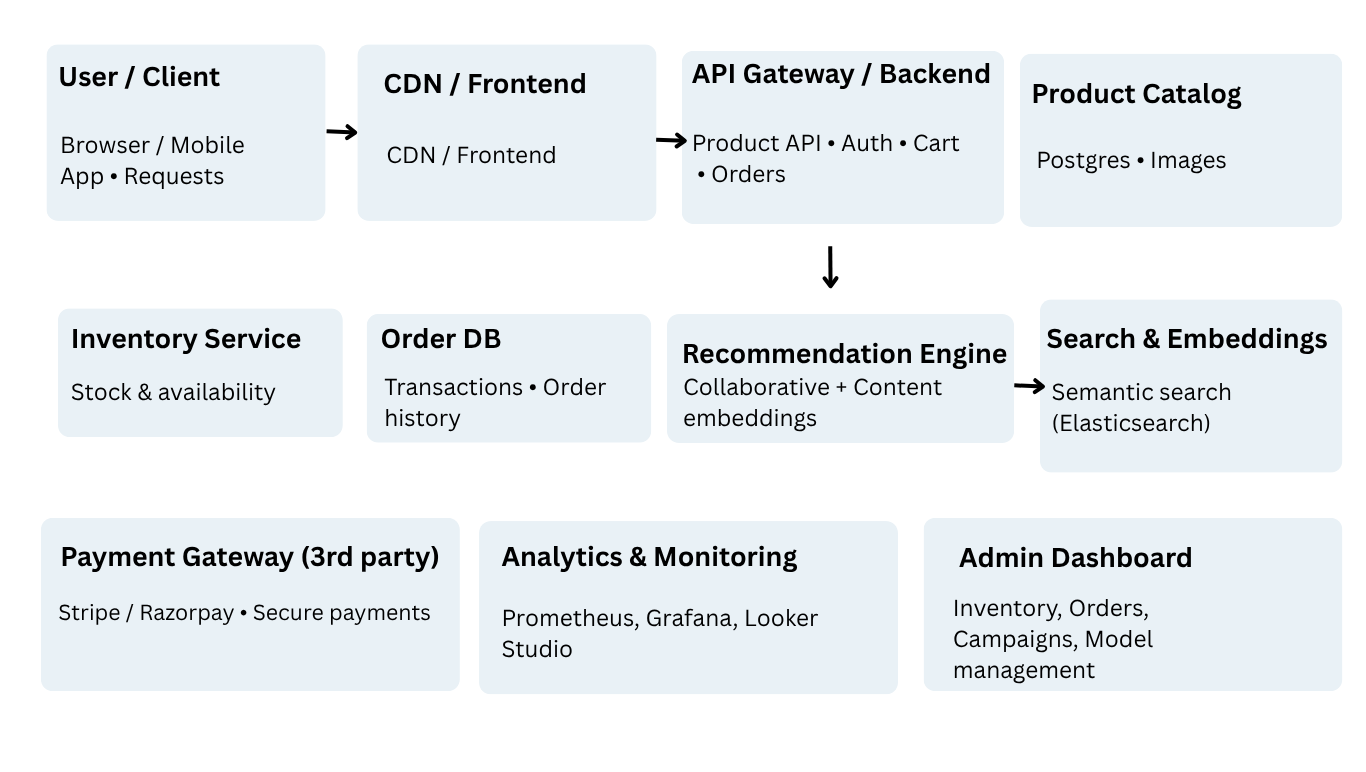
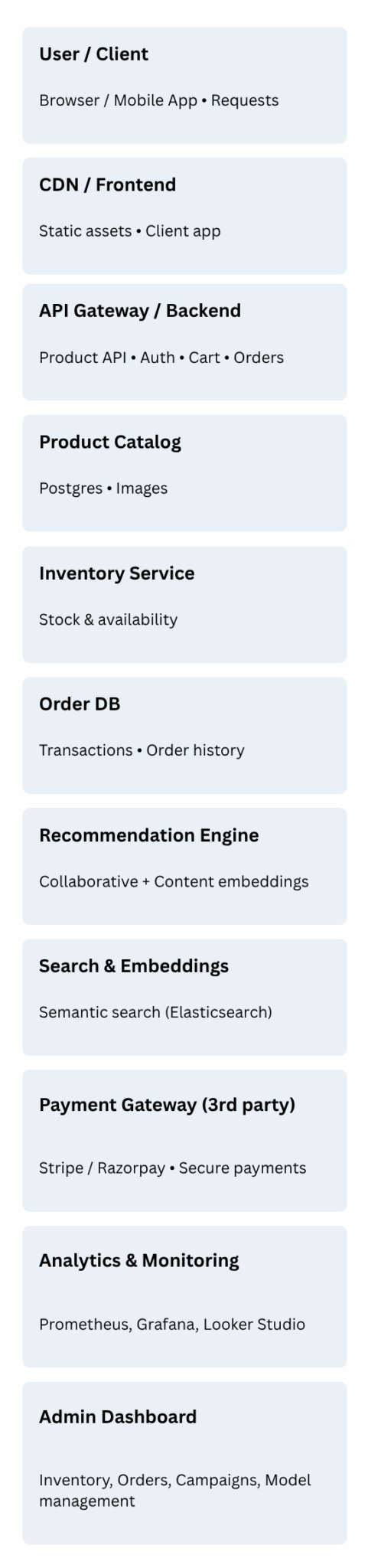
8️⃣ System Architecture Diagram
Visual representation of the system architecture (data flow from resume upload to RAG-based reasoning):
9️⃣ Expected Outcome
✨ Deployed AI-enabled e-commerce MVP with personalized recommendations and semantic search.
✨ Improved product discovery measured by CTR and CVR uplift in A/B tests.
✨ Admin dashboard for monitoring sales, inventory and AI feature impact.
✨ Documented codebase, deployment scripts (Docker), and an A/B test report detailing performance improvements.
✨ Scalable architecture ready for incremental feature enhancements (visual search, dynamic pricing).