
Generative AI & ML Job Oriented Program
#No.1 Job Oriented Program
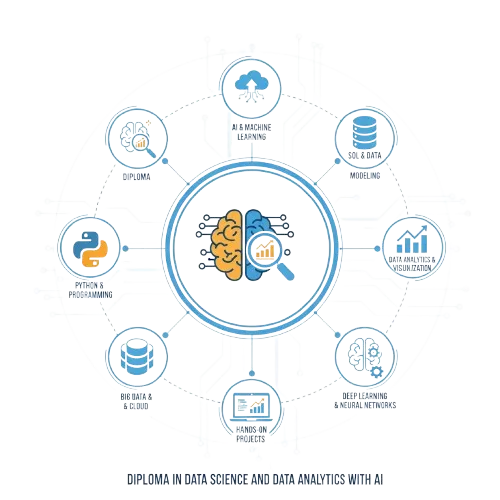
Meultech offers affordable data science course 2025 is designed to transform beginners into job-ready data professionals. You’ll master Python, SQL, TensorFlow, and Tableau, along with advanced topics like Statistical Modeling, Machine Learning, Deep Learning, and Generative AI. Perfect as a data analytics course for beginners, the program includes hands-on projects that help you build a strong portfolio and real industry exposure.
Available as a data science course offline Mumbai with flexible schedules and a data science course with EMI options, it ensures quality training without financial stress. With dedicated job assistance data science training, resume support, and interview prep, this is one of the best budget data science course options for anyone serious about launching a data-driven career in Andheri, Borivali and Mumbai.
What You'll Learn
Gain in-demand Data Science and Machine Learning skills through real-world projects and hands-on training.
Master the art of building Machine Learning models in Python using essential libraries like NumPy and Scikit-learn.
Identify and apply the most suitable Machine Learning algorithm for various real-world business problems.
Understand how to clean, organize, and prepare data for accurate model training and deployment.
Master SQL and database management techniques for efficient data extraction, transformation, and manipulation.
Develop strong skills in Data Analytics and Business Intelligence (BI) tools, such as Power BI or Tableau, for creating interactive dashboards.
Create a strong portfolio of end-to-end projects that combine Data Science, Analytics, and AI to enhance your career profile.
Dive into advanced specialized domains including Deep Learning, NLP (Natural Language Processing), and Reinforcement Learning.
Implement effective Data Governance and Data Quality protocols to ensure reliable, ethical, and compliant data practices in professional environments.
Visualize and interpret massive datasets using popular libraries like Matplotlib and Seaborn to communicate insights effectively.
Utilize cloud computing platforms (e.g., AWS, Azure, or GCP) to deploy and manage scalable Machine Learning models and Big Data workflows.
Explore the fundamentals of Data Engineering and understand the use of big data tools like Hadoop, Spark, and Kafka.
Master soft skills essential for data professionals, including technical communication, stakeholder management, and translating business needs into analytical requirements.
Our Training Process
A proven path to data science mastery
Enroll
Join the batch
Learn
Theory + Labs
Practice
Hands-on tasks
Project
Caseworks
Career
Placement support
Key Highlights
What makes our program unique
100% Live Projects Practical
Work on 15+ Industry-Level Projects & Case Studies
Top 1% Data Science Mentor Support
Train with India’s Top 1% Data Science Mentors for Maximum Impact
Job Assistance
From resume review to mock interviews to placements—we support you at every step.
Prestigious Certification
Get an industry-approved certification after completing the course.
Course Content
Comprehensive curriculum designed by industry experts
Python Basics to Advanced for AI & Machine Learning
Introduction to Python Programming Concepts
Fundamental Data Structures (lists, tuples, dictionaries, sets)
File Handling and Data Input/Output Operations
Introduction to Pandas for Structured Data Analysis
Techniques for Data Cleaning and Preprocessing
Principles of Exploratory Data Analysis (EDA)
Data Visualization Methods using Matplotlib and Seaborn
Comparative Study of Data Structures in Python, Pandas, and NumPy
Foundations of Data Wrangling with NumPy
Applied Domain Projects (Real-World Portfolio Building)
Retail Sales Performance Analysis – Identification of sales trends, seasonal demand patterns, and customer behavior using transactional datasets.
Real Estate Price Prediction & Market Trend Analysis – Modeling property prices using location, amenities, and demographic features.
Real Estate Investment Opportunity Analysis – ROI estimation, rental yield modeling, and market segmentation using property datasets.
Finance: Stock Market Exploratory Analysis – Analyzing stock volatility, sector-wise performance, and historical pricing trends.
Finance: Credit Risk Assessment – Evaluating borrower risk through exploratory techniques and loan repayment behavior analysis.
Finance: Portfolio Diversification Insights – Asset performance analysis and correlation study for balanced investment strategies.
Statistics for Intelligent Systems
Foundations of Univariate Statistical Analysis
Principles of Bivariate Statistical Analysis
Introduction to Multivariate Analytical Techniques
Measures of Central Tendency
Computation of Mean, Median, Mode, and Variance
Standard Deviation and Data Distribution Concepts
Probability Theory and Probability Distributions
Properties and Applications of the Normal Distribution
Hypothesis Testing and Inferential Statistical Methods
Machine Learning
Introduction to Machine Learning: Concepts and Applications
Rationale for Machine Learning in Modern Systems
Limitations and Challenges of Machine Learning Approaches
Classification of Machine Learning Techniques
Supervised Learning Methods
Regression Techniques
Classification Algorithms
Unsupervised Learning Methods
Clustering Techniques
Factor Analysis
Time Series Forecasting
ARIMA Modeling and Trend Analysis
Deep Learning with PyTorch, TensorFlow, and Keras
Introduction to Deep Learning Concepts
Distinctions Between Machine Learning, Deep Learning, and Artificial Intelligence
Essential Packages and Frameworks for Deep Learning
PyTorch
Keras
TensorFlow
Fundamentals of Neural Network Architectures
Artificial Neural Networks (ANN)
Recurrent Neural Networks (RNN)
Long Short-Term Memory Networks (LSTM)
Convolutional Neural Networks (CNN)
Graph Neural Networks (GNN)
Natural Language Processing (NLP) and Text Analytics
Introduction to NLTK and Text Preprocessing Techniques
Image Recognition and Image Processing
Object Detection and Classification using YOLO
Applied Deep Learning Projects (Domain-Specific Portfolio Work)
Image Classification Model – Classifying images from multi-class datasets using CNNs.
Sentiment Analysis System – NLP-based model for analyzing customer reviews, social media text, or feedback.
Object Detection with YOLO – Real-time detection and localization of objects in images/videos.
Time-Series Forecasting Using LSTM – Predicting sequential patterns such as stock prices or energy consumption.
Handwritten Digit Recognition (MNIST) – Building and training an ANN/CNN for digit classification.
Chatbot with NLP Techniques – Intent classification, response generation, and text understanding.
Real Estate Price Prediction with Deep Neural Networks – Using advanced network architectures for better regression accuracy.
Financial Risk Prediction Using Deep Models – Modeling credit risk or default probability with deep learning techniques.
Module 5 — Generative AI
Conceptual Foundations of Generative AI and Its Practical Use Cases
Comparative Study: Generative AI vs. AI Agents vs. Agentic AI
Evaluation of Open-Source and Closed-Source Model Ecosystems
Architectural Overview of Transformer Models (e.g., GPT, BERT)
Exploration of Leading LLM Providers: OpenAI, Hugging Face, LLaMA
Principles and Techniques of Prompt Engineering for LLM Optimization
Hands-on Development Using OpenAI APIs for Generative AI Applications
Generation of Vector Embeddings via OpenAI and Hugging Face Models
Data Storage and Retrieval Using Vector Databases (FAISS, Chroma)
Implementation of Retrieval-Augmented Generation (RAG) Workflows
Fine-Tuning LLMs Using LoRA, PEFT, and Hugging Face Toolkits
Development of Document-Centric Question-Answering Systems
Deployment of Scalable Generative AI Applications Using Streamlit or FastAPI
Generative AI Project (Domain-Specific)
Real Estate Domain
AI Property Valuation Assistant Using RAG and Market Data
Intelligent Real Estate Document Summarizer for Property Legal Papers
Neighborhood Insights Generator Using LLM + Geo-Data Embeddings
Finance Domain
Financial Report Analyzer Using LLM + Vector Databases
AI-Powered Personal Investment Advisor Using RAG
Automated Fraud Explanation System Using Fine-Tuned LLMs
Healthcare Domain
Medical Report Summarization Assistant Using Domain-Specific LLMs
AI Clinical Query Answering System Using RAG on Medical Textbooks
Symptom Checker Chatbot Using Prompt Engineering + Knowledge Graphs
General Enterprise / Industry
Customer Support AI Agent with Multi-Document Retrieval
Legal Document Analyzer with Semantic Search and Q&A
HR Policy Assistant Using RAG + Company Handbooks
Enterprise Knowledge Assistant Trained on Internal Docs
Advanced / Research-Level
Fine-Tuned LLaMA Model for Domain-Specific Knowledge Retrieval
Agentic AI Workflow for Autonomous Task Execution
Multi-Agent Collaboration System for Complex Problem Solving
Module 6 — LLM (Large Language Models)
- Large Language Models (LLMs).
- LLM’s Industry use cases.
- Prompting Techniques.
- One Shot Prompting.
- FewS hot Prompting.
- OpenAI – GPT 3.5 / GPT 4.
- LangChain.
- Hugging Face.
- Google PaLM
- Google Gemini / Gemini Pro / Gemini Pro Vision.
Module 7 — GPT(OpenAI,Gemini,LLAMA,GROQ)
- Identity & Access Management (IAM)
- Simple Storage Service (S3)
- Networking
- Elastic Compute Cloud (EC2) – I
- Elastic Compute Cloud (EC2) – II
- Database services
- Individual services
- Route53
- Managed application services
- Analytics applications
- Capstone projects
Module 8 — Hugging Face
- Introduction to MySQL
- Inserting data
- Crud commands
- String functions
- Basic database terminology
- Mysql constraints
- Aggregate functions
- MySQL stored procedure – I
- MySQL stored procedure – II
Module 9 — Prompt Engineering
- Tableau basics
- Maps, scatterplots & your first dashboard
- Joining and blending data, plus: dual axis charts
- Table calculations, advanced dashboards, storytelling
- Advanced data preparation
Module 10 — AI Agent and Agentic AI
- Introduction
- Connecting & shaping data with Power BI desktop
- Creating table relationships & data models in Power BI
- Analyzing data with dax calculations in Power BI
- Visualizing data with Power BI reports
- Artificial Intelligence (AI) visuals
Module 11 — RAG Application
- Customer Segmentation
- Recommender System
- Build a Chatbot
Module 11 — PowerBi
- Customer Segmentation
- Recommender System
- Build a Chatbot
Module 11 — MYSQL
- Customer Segmentation
- Recommender System
- Build a Chatbot
Module 11 — Advanced Excel
- Customer Segmentation
- Recommender System
- Build a Chatbot
Module 11 — GCP(ONLINE)
- Customer Segmentation
- Recommender System
- Build a Chatbot
Capstone Projects
🔍
Intelligent Resume Screener using NLP + RAG
Natural Language Processing + Retrieval-Augmented Generation
- Build an NLP pipeline to extract skills, experience, and education from resumes.
- Create a vector database (FAISS) of job descriptions.
- Use a RAG model to match candidate resumes to job postings dynamically.
- Output: Ranking of best-fit candidates and a Chatbot interface for HR queries.
🤖
Customer Segmentation & Targeted Marketing Engine
Clustering + Consumer Behavior Analytics
- Predict demand for products using ML regression models.
- Apply Reinforcement Learning to optimize inventory restocking & routing.
- Simulate supply chain operations and reduce cost per delivery.
- Output: Dynamic RL-powered supply chain dashboard.
🛡️
AI-powered Fraud Detection System
Machine Learning + Anomaly Detection
- Train supervised + unsupervised models on financial transaction datasets.
- Use anomaly detection for new fraud patterns.
- Build a dashboard showing fraud probability and visual transaction clusters.
- Output: Real-time fraud alerting web dashboard.
⚡
Energy Consumption Prediction and Optimization
Time Series Forecasting + Predictive Analytics
- Collect smart meter energy consumption data.
- Build a forecasting model using LSTM / Prophet to predict energy demand.
- Suggest optimal load distribution or appliance usage.
- Output: Real-time energy dashboard with recommendations for saving electricity.
🚦
Smart Traffic Violation Monitoring using Computer Vision
Deep Learning + Object Detection
- Detect traffic rule violations (no helmet, red light jump, wrong lane) using real CCTV footage.
- Integrate OCR for license plate recognition.
- Send auto-generated violation reports.
- Output: Intelligent traffic surveillance and automated penalty system.
💰
AI Financial Advisor Agent
Multi-Agent System + Generative AI
- Build AI Agents that perform different roles: Market Analyst, Risk Evaluator, and Portfolio Rebalancer.
- Agents collaborate autonomously to provide personalized investment advice.
- Users can chat with the system for portfolio insights.
- Output: Autonomous, explainable AI-driven portfolio recommendations.
📊
Retail Demand Forecasting & Assortment Optimization Platform
Time-series forecasting + assortment optimization + data-driven merchandising
Collect and clean sales, pricing, promotion, and inventory data.
Build SKU-level demand forecasting models (Prophet / LightGBM).
Recommend optimal inventory & assortment using optimization algorithms.
Deploy a dashboard showing forecasts, stock actions, and KPIs.
📉
Customer Churn Prediction & Retention Engine
Predictive Modeling + Explainable AI
Analyze customer data: usage, billing, complaints, tenure.
Train ML model (XGBoost / Random Forest) to predict churn probability.
Use SHAP explainability to show factors leading to churn.
Build a Retention Recommender (discount, callback, plan upgrade).
Output: Interactive dashboard showing churn risk, reasons, and recommended action plan.
📊
AI-driven Marketing Campaign Performance Analyzer
Analytics + NLP Insights + Optimization
Ingest data from Google Ads, Meta Ads, Email Campaigns, Website Analytics.
Use time-series forecasting to predict conversions & ROAS.
Apply NLP to evaluate ad text quality & sentiment.
Automatically detect performing vs. non-performing campaigns.
Output: Smart dashboard recommending scaling/pausing campaigns + creative suggestions.
Things You Should Know
Important notes, tips and expectations for MeulTech learners — short, clear and action-oriented.




Course Certification

Certified Data Science & AI Professional
This official certification is your professional proof and a clear indicator of your full expertise in Data Science, Analytics, and AI, designed to accelerate your career growth.
Why Learners Choose Us
Learn, build, and get hired — with expert-led, hands-on training
Industrial Expert Trainer
Get direct guidance from seasoned data scientists and AI specialists actively working in top tech companies — their real-world experience forms the core of your learning.
01
100% Practical Training
We prioritize hands-on application over lectures. You'll gain tangible skills by coding, building models, and solving problems using live, complex datasets.
02
Industry Oriented Capstone Projects
Create end-to-end capstone projects that simulate real business challenges — a portfolio that proves your expertise to recruiters.
03
Global Certification
Earn a valuable Certified Data Science & AI Professional credential — an official certificate that boosts your profile and validates your expertise worldwide.
04
Dedicated Practice Space with laptop
Benefit from a dedicated, well-equipped practice facility. We provide high-spec laptops and software during lab time, ensuring zero technical friction during study hours.
05
Personalized Instructor Support
Clarify complex concepts immediately with our one-on-one doubt-solving sessions — trainers committed to your personalized understanding.
06
Future-Proof, Dynamic Curriculum
Our syllabus is updated with the latest in Generative AI and MLOps. Learn modern techniques using cutting-edge AI tools and methodologies.
07
ATS Based Resume Building
Receive coaching to craft an ATS-optimized resume and refine your LinkedIn profile — make sure your applications pass screening software and capture recruiter attention.
08
Linkedin Profile Building
Receive coaching to craft an ATS-optimized resume and refine your LinkedIn profile. Maximize your visibility to recruiters and capture their immediate attention.
09
What Can You Become?
Career roles after completing the Digital Marketing course
Data Scientist
Data Analyst
Machine Learning Engineer
Data Engineer
Data Science and Data Analytics with AI
Deep Learning Specialist
Data Visualization Expert
Big Data Analyst
Predictive Analytics Specialist
Turn your Data Science and Data Analytics with AI skills into a career — pick a role and build projects for your portfolio.
Frequently Asked Questions
Everything you need to know about the course
How is this Diploma different from a standard Data Analyst or Data Science course?
This program is unique because it integrates all three essential career paths. It starts with Data Analytics (tools like Power BI/Tableau) to ensure you can manipulate and visualize data. It then progresses to Data Science (core ML algorithms) and finishes with Applied AI (Deep Learning, Generative AI, and Cloud deployment). You don’t just learn one specialization; you graduate with a complete skill set for future-proof roles.
Do I need a coding or technical background to enroll?
No, prior coding experience is not strictly required. The diploma begins with foundational modules, including comprehensive training in Python and R Programming (Module 1), starting from the basics. We ensure you have a solid technical base before moving into Machine Learning and Deep Learning concepts.
What is the focus on Data Analytics, and which tools are covered?
Data Analytics is a crucial pillar of this diploma. You will master the process of data extraction, cleaning, and reporting. Key tools include MySQL for robust data management, and industry-leading Business Intelligence (BI) platforms like Power BI and Tableau for creating professional, interactive dashboards (Modules 2 and 3).
How do the AI and Machine Learning modules prepare me for a job?
The program goes beyond theory. You will cover Core Machine Learning (Module 4) for foundational models, and then dive deep into advanced topics like Deep Learning, NLP, and Generative AI (Module 5 & 6). Crucially, you will also learn Cloud Deployment (AWS) (Module 7) and complete a final Capstone Project (Module 8) to ensure you can build and deploy production-ready AI models.
What Our Students Say
Real feedback from learners who completed MeulTech programs